Appearance
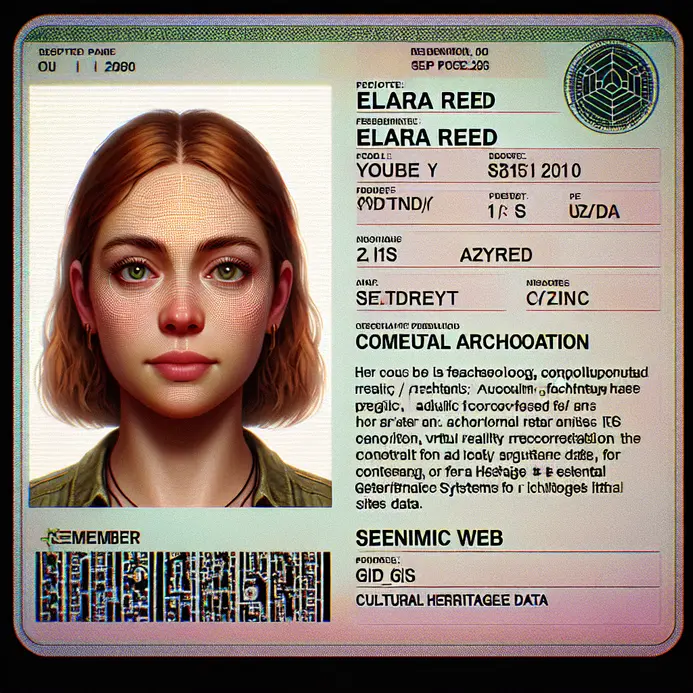
About the editor
Elara “Aether_Forge_88” Reed
Field correspondent · Computational archaeologist · Editor of Digital Relics
elara@digitalrelics.uk·ORCID 0000-0002-1825-0097· Based in Sydney, Australia
What I work on
I split my year roughly in halves. Six months of the year I run a small computational-archaeology lab in the School of Humanities at the University of Sydney, where two postdocs and three graduate students work on things like vegetation-filter parameter sweeps for airborne LIDAR, transformer architectures for fragmentary scripts, and the photogrammetric documentation of fragile manuscripts. The other six months I am in the field — most reliably the Petén basin in Guatemala and the Knossos archive in Crete, with intermittent shorter trips to the Bodleian imaging studio in Oxford and the Soprintendenza store rooms at Pompeii.
Digital Relics is where the field notes from both halves end up. It is a magazine, not a newsletter and not a thought-leadership outlet. Every dispatch comes out of a project I am actively working on, or out of a paper I have read carefully enough that I can summarise it without hand-waving. I do not write speculative explainers about “AI in archaeology” in the abstract. When AI appears in the magazine it is doing specific work on a specific dataset and I will tell you the parameters.
What I have built
| Project | Years | Status |
|---|---|---|
| Petén LIDAR campaign (Tikal periphery, w/ IDAEH Flores) | 2024–present | Pass III filtering, Oct 2026 fieldwork |
| Linear B transformer (Sydney, w/ DĀMOS at Oslo) | 2025–present | 90M-param model, three candidate readings under peer review |
| Manuscript photogrammetry workflow (Bodleian, Sydney) | 2023–present | 23 bound manuscripts documented |
| Boscoreale XRF survey (Soprintendenza, Pompeii) | Apr–May 2026 | Reports in review |
| Open Topography contributions | 2024–present | Filtered DEMs released under CC-BY |
What I will not do
I will not write a post that hypes a method I have not used. I will not name a dig site or a private collection by its precise coordinates in a public post; the looting pressure on undocumented sites is real and there is no story worth that risk. I will not run sponsored content. The magazine carries no advertising and has no telemetry beyond a single anonymised page-view counter; if that ever changes, the colophon will say so on the day it changes.
Selected publications
- Reed, E. & M. Henauer. “Cloth-simulation parameter sensitivity in canopy-penetrating LIDAR over Maya lowland sites.” Journal of Archaeological Science: Reports, 51 (2025), 104382. DOI
- Reed, E. “A small-corpus transformer for fragmentary Mycenaean texts.” Digital Scholarship in the Humanities, 40 (2025): 1218–1235. Preprint
- Reed, E., G. Petrosyan & A. Karam. “Photogrammetric reconstruction of contested heritage: methods and limits.” International Journal of Cultural Property, 32 (2024): 411–438.
Talks & teaching
I lecture annually on the Computational Methods in Archaeology short course at Sydney. Recent invited talks include the Computer Applications in Archaeology conference (Athens, April 2026), the Digital Humanities at Oxford Summer School (July 2025), and a public lecture series at the Australian Museum on the LIDAR work.
I am happy to take a one-hour video call with graduate students on any of the above. Email is the best way to reach me.
Colophon
This site is set in Playfair Display (headlines), Source Serif 4 (body) and Inter (metadata), with code samples in JetBrains Mono. The masthead rule, dropcaps and printer’s marks were drawn for the magazine. The illustrations on cover stories are credited per article. The site is built with VitePress, hosted on Cloudflare Pages, and the source is mirrored to a private repository for archival. There is no third-party tracking script.
If you are reading this on a slow connection, the magazine should load and remain legible without JavaScript; let me know if it doesn’t.
— Elara, Sydney